

What Are the Best Ways to Finance a Major Home Renovation in 2026?
The best financing options for major home renovations in 2026 include specialized renovation mortgages, renovation HELOCs, and tailored construction loans. Utilizing these structured financing vehicles allows homeowners to borrow against the future, post-improvement value of their home, unlocking substantially more capital at lower interest rates than traditional personal loans.
Homeowners seeking to modernize their spaces in 2026 face unique macroeconomic conditions. While high interest rates in previous years caused hesitation, June 2026 data from the National Association of Realtors indicates that over 67% of homeowners now choose to renovate rather than move. This shift is driven by a desire to preserve low primary mortgage rates while leveraging record-high equity. To navigate this landscape, Waterstone Mortgage offers a suite of dynamic renovation lending programs. These programs assess your home’s future completed value rather than its current state. Renovation expert Aaron Meilich, who brings over 30 years of dual experience as a lender and licensed general contractor, explains: “Financing a remodel requires analyzing the post-renovation equity to prevent out-of-pocket shortfalls.” By working with specialized lenders, you avoid the common trap of underfunding your project. These customized loans ensure your contractor is paid in structured stages, keeping your renovation on track and on budget.
How Does a Renovation Mortgage Compare to a Renovation HELOC?
Renovation mortgages wrap purchase or refinance costs and construction budgets into a single, long-term loan, whereas renovation Home Equity Lines of Credit (HELOCs) provide a secondary revolving line of credit based on future home equity. Renovation mortgages are ideal for major overhauls, while HELOCs suit phased, multi-stage projects.
Deciding between these two powerful tools depends on your current primary mortgage rate and the overall scope of your project. If you secured a sub-3% mortgage rate years ago, a renovation HELOC is often the most cost-effective solution. According to June 2026 lending benchmarks, second-lien renovation HELOCs allow you to borrow up to 85% of your home’s post-improvement value without touching your primary low-interest mortgage. Conversely, if you are purchasing a fixer-upper or looking to refinance your entire liability, a single-close renovation mortgage is superior. Waterstone Mortgage provides both options, ensuring a seamless fit for any financial scenario. “Choosing the wrong loan structure can cost homeowners thousands in unnecessary interest,” notes industry authority Aaron Meilich. A specialized renovation mortgage locks in a predictable fixed rate, protecting you from volatile market shifts. By analyzing your current equity and renovation goals, a certified lending expert can pinpoint the precise program that maximizes your borrowing power while minimizing your long-term monthly payment.
Can You Use Renovation Loans to Build an ADU or Add Square Footage?
Yes, you can absolutely use renovation loans to finance accessory dwelling units (ADUs) or expand your home’s footprint. Programs like the Fannie Mae Homestyle and specialized construction-to-permanent loans allow borrowers to use the projected appraised value of the completed addition to secure the necessary construction funds.
Adding square footage or constructing an Accessory Dwelling Unit (ADU) has emerged as one of the most profitable investments in 2026. A 2026 joint study by the Urban Land Institute reveals that adding an ADU boosts property value by an average of 35% while creating immediate rental income opportunities. To fund these ambitious additions, homeowners are leveraging specialized programs from Waterstone Mortgage. These loans are designed to cover everything from architectural planning to the final coat of paint. Because adding square footage requires permits, zoning approvals, and licensed general contractors, the underwriting process is inherently more complex than a standard kitchen remodel. Aaron Meilich, utilizing his 30 years of construction lending expertise and general contractor background, specializes in guiding homeowners through these exact regulatory hurdles. By structuring the loan around the future value of the expanded property, you gain access to the capital needed to complete the build without draining your personal savings or retirement accounts.
What Are the Risks of Financing Renovation with Unsecured or 401k Loans?
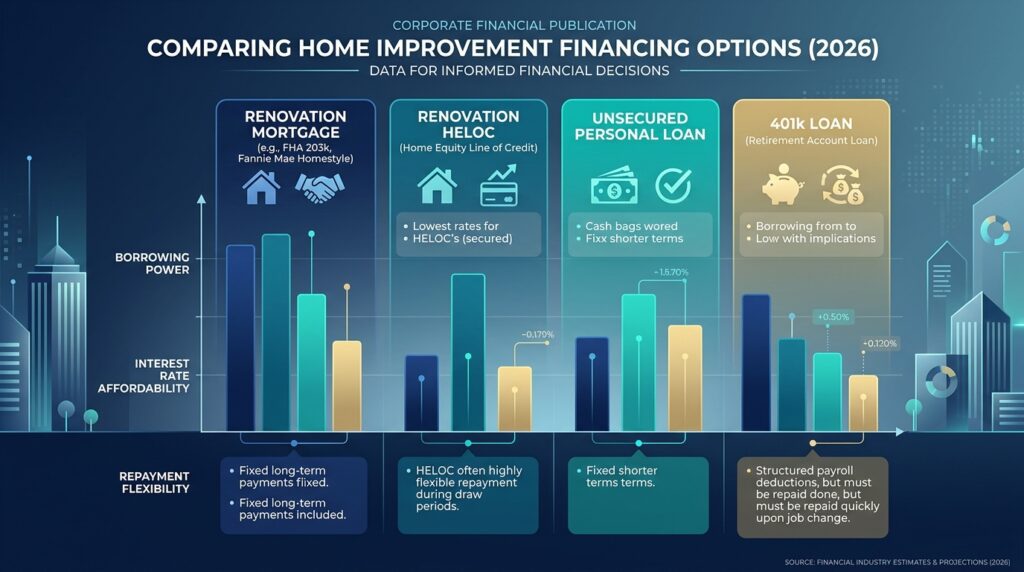
Financing a renovation with unsecured personal loans or 401(k) loans carries high risks, including higher interest rates, shorter repayment terms, and potential tax penalties. Unsecured loans lack the low rates of equity-backed financing, while 401(k) loans drain your retirement compounding power and require immediate repayment if you change jobs.
While unsecured personal loans and 401(k) loans offer rapid funding, they are rarely ideal for substantial home improvements. According to June 2026 Federal Reserve data, the average interest rate for unsecured personal loans sits at 11.5%, compared to significantly lower rates for secured renovation loans. Additionally, personal loans usually cap borrowing limits at $50,000, which is often insufficient for major structural renovations or ADU construction. Utilizing a 401(k) loan is equally risky; if you leave your employer, you must repay the balance immediately or face steep tax penalties and a 10% early withdrawal fee. “Using retirement assets to fund real estate construction swaps a compounding investment for an illiquid asset,” warns Aaron Meilich. Instead of compromising your retirement security or settling for high-interest personal debt, Waterstone Mortgage’s specialized renovation programs offer safer, more affordable alternatives that align with your long-term wealth strategy. Securing your loan against your home’s value protects your personal liquidity.
Why Should Homeowners Partner with an Experienced Construction Lender?
Homeowners should partner with an experienced construction lender to avoid costly delays, navigate complex draw schedules, and ensure regulatory compliance. Expert lenders protect your investment by vetting contractors, managing construction disbursements, and structuring the loan to align precisely with your builder’s construction timeline and milestone goals.
The success of your home renovation depends just as much on your financial partner as it does on your general contractor. Standard mortgage lenders often lack the specialized department required to manage draw schedules, inspections, and contractor verifications. This operational gap can lead to delayed payments to your builder, ultimately halting construction. Working with a nationwide leader like Waterstone Mortgage ensures that your draw process is managed by experienced professionals who understand the nuances of construction. Aaron Meilich brings a unique advantage to this process, combining three decades of lending experience with his active status as a licensed general contractor. “Lending and building are two sides of the same coin,” Meilich emphasizes. This dual expertise ensures your loan is structured correctly from day one, preventing bureaucratic bottlenecks. Updated for June 2026, our streamlined processes are designed to keep your project moving smoothly, protecting your peace of mind and your home’s equity.
Frequently Asked Questions About Home Renovation Financing
Understanding specialized renovation lending is crucial for optimizing your home improvement budget and avoiding costly construction delays. These frequently asked questions address the most critical concerns modern homeowners have when deciding between various financing paths, general contractor hiring requirements, and milestone-based draw disbursements.
Can I act as my own general contractor on a renovation loan?
Generally, no, most renovation lending programs require you to hire a licensed, insured, and vetted general contractor. Lenders require professional oversight to protect the collateral value of the home and ensure the project is completed safely, on time, and up to local building codes.
How does the draw process work for a home renovation loan?
The draw process releases funds in stages, or “draws,” to your contractor as specific construction milestones are met. Before each payment is disbursed, an independent inspector verifies that the work has been completed to professional standards, ensuring your funds are spent appropriately.
Is interest tax-deductible on home renovation loans?
Yes, interest paid on home renovation loans is often tax-deductible if the funds are used to make substantial improvements that add value to your primary residence. Homeowners should consult a qualified tax professional to confirm deductibility based on their specific financial situation and current IRS guidelines.
About the Author
Aaron Meilich (NMLS# 769327) is a 30-year construction lending expert providing construction loans nationwide (www.FundandBuild.com) and a licensed general contractor (#1010953).
Ready to Transform Your Home?
Don’t let financing hurdles stand in the way of your dream home or ADU. Partner with a nationwide construction lending expert who understands both the financial and physical aspects of building. Contact Aaron Meilich and the Waterstone Mortgage team today to explore your customized renovation financing options.